The commercial induction kitchen power requirement depends on three numbers. The first is the kW rating of each machine. The second is how many machines run at the same time. The third is the power factor, which turns kW into the kVA your electricity company (DISCOM) approves. Once these are known, the supply type, cable size, fixed charge and backup all follow. This guide works out four kitchen sizes, from a two-hob thela to a 100-cover hotel kitchen. It also covers the Delhi Electricity Regulatory Commission (DERC) rules for each.
Gas kitchen
16.6 kW connectedDishwasher, fridges, exhaust, air conditioning and lights. The cooking itself runs on LPG.
Hybrid electric kitchen
46.4 kW connectedThe same kitchen with an induction range, bulk cooker and combi oven added. The tandoor and wok stay on gas.
Illustrative 30-seat restaurant (Example B below). Equipment ratings come from maker sheets and listings, Nov 2026. Fridge and air-conditioning ratings are assumptions.
What is the difference between kW, kVA and kVAh?
The kW (kilowatt) figure is how much power a machine actually uses to make heat. The kVA (kilovolt-ampere) figure is how much power the connection must supply to run it. The kVAh figure is kVA used over time, counted on the meter like units. Power factor (PF) is a number between 0 and 1 that links the two. It shows how much of the supplied power does useful work.
The formula is kW = kVA × PF, so kVA = kW ÷ PF. At a PF of 1, kW and kVA are the same. Below 1, the kVA figure is higher than the kW figure for the same cooking. For example, 19 kW at PF 0.95 needs 19 ÷ 0.95 = 20 kVA.
The DISCOM approves a sanctioned load for each connection, in kW or kVA. That is the most power the connection is meant to draw. A fixed charge is a monthly amount paid on each kVA, even if no units are used.
DERC defines average power factor as kWh divided by kVAh in one billing period. Maximum demand is the highest average load over any 30 minutes in a row. The meter records it in each bill cycle (DERC Supply Code 2017, Reg 2(12) and 2(40), checked Nov 2026).
| Unit | What it measures | Where it shows up |
|---|---|---|
| kW | Power the machine uses; its nameplate rating | Equipment labels; sanctioned load can be stated in kW |
| kVA | Power the supply must carry, kW ÷ PF | Sanctioned load, contract demand and fixed charges at ₹250 per kVA a month |
| kVAh | kVA used over time | Energy charge at ₹8.50 per kVAh above 3 kVA |
| Maximum demand | Highest 30-minute average load in the cycle | Billing demand and the overload surcharge |
Delhi bills shops and restaurants for energy in kVAh, read from the meter. So a low power factor raises the units on the bill. Here is a worked example. 100 kWh of cooking at PF 0.95 shows up as about 105 kVAh, or ₹895 at ₹8.50. At PF 0.90 it shows up as about 111 kVAh, or ₹944.
The ₹8.50 per kVAh and ₹250 per kVA rates come from the DERC Tariff Schedule FY 2020-21. Tata Power-DDL (TPDDL), a Delhi DISCOM, was still billing them in November 2024. DERC has issued no new tariff order since 2021 (GoodReturns, Jan 2026). Outside Delhi, many companies bill in kWh, the unit on a normal bijli bill. Check your own bill for the unit and rate.
What an hour of cooking costs is a separate question. The guide to the running cost of induction vs LPG works it out per hob-hour.
How much power does each induction and electric kitchen appliance draw?
A single commercial induction hob uses 3.5 to 5 kW. An induction wok uses about 8 kW. Induction bulk cookers and electric fryers use 15 to 30 kW each. Combi ovens, convection ovens and dishwashers add 3.7 to 19 kW each. These ratings are printed on each machine’s rating plate (nameplate). They are the start of every load sum.
Most of these machines sit on a restaurant cooking line. The ratings below come first from maker sheets: Sirman, B&S Black, Electrolux, Unox, Winterhalter, Meiko and Rational. The rest come from IndiaMART listings: Lorman, Pankti, Global Kitchen India and Maha Engineering. All were checked in November 2026. Some combi oven and wok figures come from shop listings, not the maker’s own sheet.
| Equipment | Rated power | Supply as listed |
|---|---|---|
| Single induction hob | 3.5 kW | 220 V single phase |
| Larger induction hob | 5 kW | Three phase or single phase; listings differ |
| 4-zone induction range | 14 kW | Not stated |
| Induction wok | 8 kW | 400–415 V three phase, 12–12.5 A per phase |
| Induction tilting bulk cooker, 200–300 L | 20–30 kW | Not stated |
| Induction frying pan, 30 L | 15 kW | Three phase |
| Electric fryer, 23 L | 17.2–18 kW | 400 V three phase |
| Electric tandoor | 2–6 kW | Single or three phase |
| Combi oven, 6 to 10 trays | 10.8–18.9 kW | 400 V three phase, 3 × 16 A to 3 × 32 A |
| Convection oven, 5 GN | 9.3 kW | Three phase 14 A, or single phase 24 A |
| Undercounter dishwasher | 3.7–9.7 kW | Three phase; single-phase versions 2.9–4.1 kW |
| Reach-in refrigerator, 1,430 L | 0.2 kW | 220–240 V single phase |
| Exhaust blower, 2–3 HP | ≈1.5–2.2 kW | Three phase |
Hadala’s range of electric and induction hot plates includes a six-zone unit at 3.5 kW per zone. That means about 21 kW when all six zones run at once. The page for Hadala electric fryers lists a 21 L tank at 20 kW total power. That is close to the 17–18 kW of a 23 L Electrolux model. Neither page states the supply voltage or phase. Confirm both before an electrician plans the circuit.
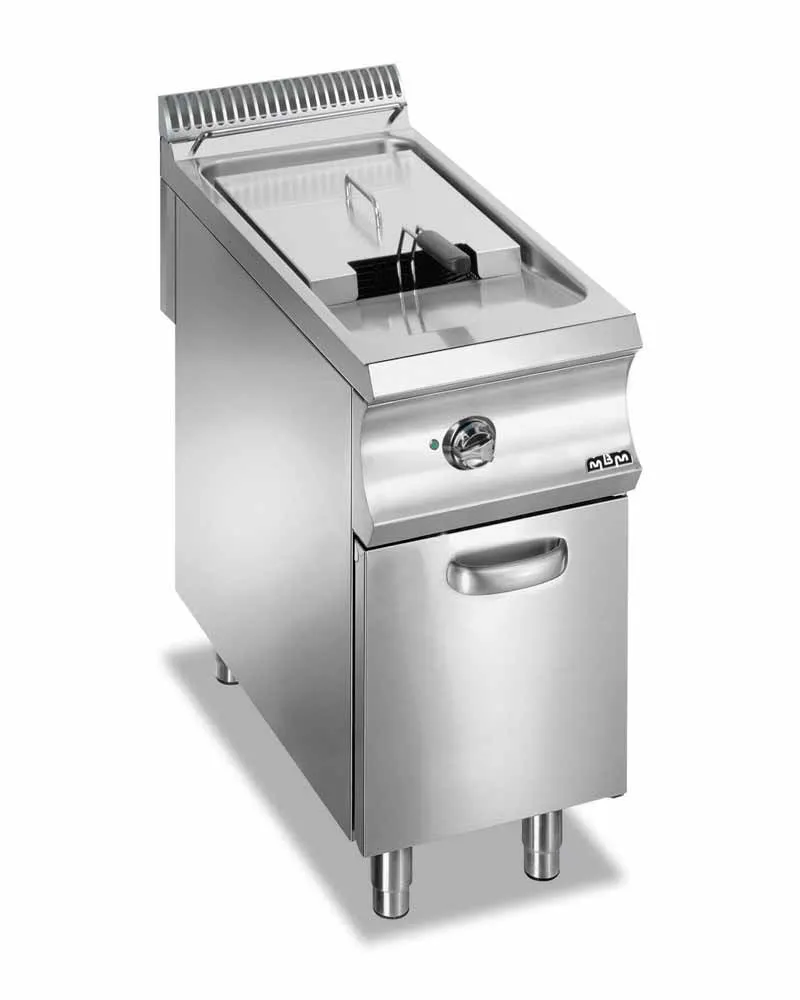
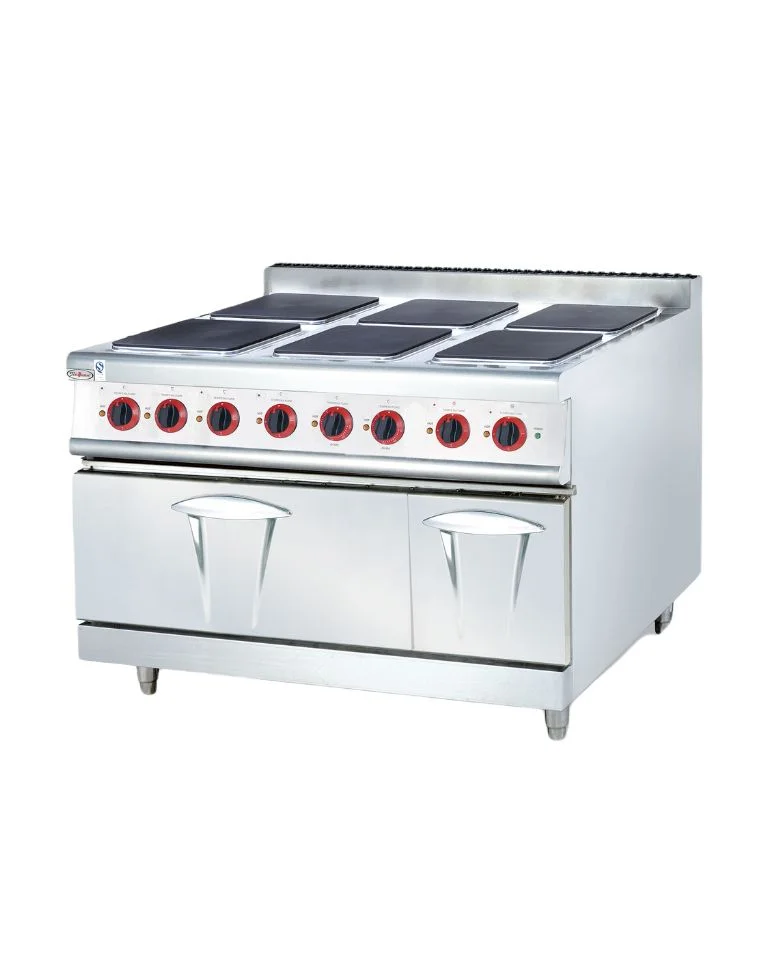
Hadala 6-zone electric induction hot plate
Six cooking zones at 3.5 kW each, a 304 stainless steel body and a digital controller, 1200 × 900 × 940 mm. Plan for about 21 kW if all six zones run at full power.
View specificationsHow do you work out the current per phase from kW?
Current is the flow of electricity in a wire, measured in amps (A). A three-phase supply brings power on three live wires, called phases. A single-phase supply uses one live wire and a neutral. At 415 V three phase and PF 1, each kW draws about 1.39 A per phase. On 230 V single phase, the same kW draws about 4.3 A. That is about three times as much through one wire.
- Convert to wattsAn 8 kW induction wok is 8,000 W.
- Work out the divisor1.732 × 415 V × PF 1.0 = about 719.
- Divide8,000 ÷ 719 = about 11.1 A per phase. The B&S Black sheet for an 8 kW wok lists 12.5 A per phase. That is a little above the PF 1 figure.
A small owner can do the same sum for one hob. A 3.5 kW hob on 230 V single phase draws 3,500 ÷ 230 = about 15.2 A at PF 1. DERC sets three-phase LT (low tension, the normal low-voltage supply) at 400 V between phases. It allows ±6% at the point of supply (DERC Supply Code 2017, Reg 4). At 400 V, currents run about 4% higher than the 415 V figures in this guide.
Does a commercial induction kitchen need single-phase or three-phase supply?
Most commercial induction kitchens need three-phase supply. In Delhi, a load up to 10 kW gets single-phase supply at 230 V. A load above 10 kW, up to 200 kW (215 kVA), gets three-phase, 4-wire supply at 400 V. That is the rule in the DERC Schedule of Charges and Procedure 2017, clause 1(1) (checked Nov 2026). Two 3.5 kW hobs, a fridge and lights can fit under 10 kW. Almost any induction line bigger than that cannot.
Other states set their own limits. In Indore, Lucknow or any city outside Delhi, ask your electricity company for its single-phase limit.
| Point | Single phase | Three phase |
|---|---|---|
| Voltage | 230 V phase to neutral | 400/415 V between phases |
| DERC load band | Up to 10 kW | Above 10 kW to 200 kW/215 kVA (LT) |
| Current for 10 kW at PF 1 | ≈43 A | ≈14 A per phase |
| Typical kitchen fit | 1–2 × 3.5 kW hobs, fridge, lights | Woks, bulk cookers, combi ovens, fryers, multi-zone ranges |
| Time-of-day tariff | Not mandatory below 10 kW/11 kVA | Mandatory from 10 kW/11 kVA for non-domestic |
| Same 9.3 kW Unox oven | 24 A, 32 A breaker | 14 A per phase, 16 A breaker |
The oven row shows the real gain. On three phase, the same oven draws well under two-thirds of the single-phase current per wire. So it needs a smaller breaker and thinner cable. Suppose a single-phase customer’s meter later records a three-phase-sized load. Then the DISCOM changes the supply type (Schedule of Charges 2017, clause 1(1) proviso).
What is the commercial induction kitchen power requirement for four kitchen sizes?
A two-hob stall needs about 7.5 kW, which fits a normal single-phase connection. A small cloud kitchen needs about 19 kW of maximum demand. A 30-seat hybrid restaurant needs about 39 kW. A 100-cover full-electric kitchen needs about 92 kW before air conditioning. These are worked figures from published equipment ratings, not client records.
A demand factor is the share of the total kW that actually runs at the same time. Thermostats switch cooking machines on and off, so they rarely all draw full power together. Each example adds up the kW ratings to get the connected load. It then applies a demand factor to the cooking and dishwashing machines.
No Indian demand factor for kitchens was found. So the examples borrow the US National Electrical Code (NEC) table for commercial kitchen equipment, as a reference only. It uses 100% for 1–2 machines, 90% for 3, 80% for 4, 70% for 5 and 65% for 6 or more. The result is never less than the two largest machines added together. The source is US NEC Table 220.56, 2023 edition (renumbered 120.56 in 2026). Fridges, exhaust, lights and air conditioning stay at 100%.
In short: maximum demand = cooking kW × demand factor + all other kW.
Starter example: momo thela or small cloud kitchen with two hobs
| Item | kW |
|---|---|
| 2 × 3.5 kW induction hobs | 7.0 |
| 1 refrigerator (assumed) | 0.5 |
| Connected load | 7.5 |
Take a momo or chaat thela in Indore, or a small cloud kitchen in Lucknow. It runs two 3.5 kW induction hobs and one fridge. The two hobs are 7 kW, and the fridge adds about 0.5 kW. With only two cooking units, the demand factor is 100%. So the maximum demand is the full 7.5 kW.
At PF 0.90, that is 7.5 ÷ 0.90 = about 8.3 kVA. On 230 V single phase, the current is 7,500 ÷ (230 × 0.90) = about 36 A. Each hob alone draws about 15.2 A. With one hob and the fridge, the load is only about 4 kW.
In Delhi, 7.5 kW is under the 10 kW single-phase limit, so a normal connection works. The time-of-day tariff is not mandatory below 10 kW. The fixed charge would be 9 kVA × ₹250 = ₹2,250 a month, since part kVA is rounded up. On an 8 kW sanction, the security deposit at ₹4,500 per kW is ₹36,000. Service line charges are ₹3,000 + 3 × ₹500 = ₹4,500.
Indore and Lucknow have their own tariffs, limits and deposits. Ask your electricity company for its rates, and check your bijli bill for your sanctioned load. Check that load first. 76% of street vendors in a Shell Foundation survey had only a 1 kW sanctioned load (Shell Foundation, Mar 2026). One 3.5 kW hob is already more than three times that. The same report found that poor wiring and sockets also held back induction use.
Example A: delivery-only cloud kitchen, all electric
| Item | kW |
|---|---|
| 2 × 3.5 kW induction hobs | 7.0 |
| 1 × 5 kW induction wok or hob | 5.0 |
| Fryer (assumed 6 kW, as electric kadhai listings show) | 6.0 |
| 2 refrigerators or freezers (assumed) | 1.0 |
| Exhaust blower, 2 HP | 1.5 |
| Mixer-grinder and small appliances | 1.0 |
| Lights, fans, billing terminal | 1.5 |
| Connected load | 23.0 |
The four cooking units total 18 kW. Four units get an 80% demand factor, so 18 × 0.80 = 14.4 kW. That is above the two-largest floor of 11 kW (6 + 5). Adding the other 5.0 kW gives a maximum demand of about 19.4 kW.
At PF 0.95 that is 20.4 kVA, and at PF 0.90 it is 21.6 kVA. That means about 28 to 30 A per phase at 415 V. On single phase, the same load would draw about 84 A at 230 V. It is also above Delhi’s 10 kW single-phase limit, so it needs three phase.
In Delhi this kitchen pays a fixed charge of about 21–22 kVA × ₹250. That is ₹5,250–5,500 a month, and the time-of-day tariff applies. On an illustrative 20 kW sanction, the security deposit at ₹4,500 per kW is ₹90,000. Service line and development charges are ₹3,000 + 15 × ₹500 = ₹10,500. These costs belong next to equipment and rent when working out what a cloud kitchen costs to set up.
Example B: 30-seat restaurant, hybrid kitchen
| Item | kW |
|---|---|
| 4-zone induction range (4 × 3.5 kW) | 14.0 |
| Induction bulk cooker | 5.0 |
| Combi oven, 6 trays | 10.8 |
| Undercounter dishwasher | 7.7 |
| Refrigeration (assumed) | 1.5 |
| Exhaust blower, 3 HP | 2.2 |
| 2 × 1.5-tonne air conditioners (assumed) | 3.2 |
| Lights, billing and small appliances | 2.0 |
| Connected load | 46.4 |
The cooking and dishwashing group totals 37.5 kW across four units. At 80%, that is 30.0 kW. That is above the two-largest floor of 24.8 kW (14 + 10.8). Adding 8.9 kW of other loads gives about 38.9 kW. That is 40.9 kVA at PF 0.95 or 43.2 kVA at PF 0.90. It means about 57 to 60 A per phase. The fixed charge comes to about ₹10,250–11,000 a month.
After the induction range, the biggest single item is a 10.8 kW electric combi oven. On its own, it is above the single-phase limit. The same kitchen cooking on gas would connect only about 16.6 kW. Keeping the tandoor and wok on gas is a common first step in switching a restaurant from LPG. It holds this kitchen near 39 kW of demand.

Example C: 100-cover full-electric kitchen
| Item | kW |
|---|---|
| 2 × 4-zone induction ranges | 28.0 |
| 2 × 8 kW induction woks | 16.0 |
| Induction tilting bulk cooker, 200 L | 20.0 |
| Electric fryer, 23 L | 18.0 |
| Combi oven, 10 trays | 18.9 |
| Convection oven, 5 GN | 9.3 |
| Electric tandoor | 6.0 |
| Dishwasher (20 A version) | 9.7 |
| Refrigeration with small walk-in (assumed) | 3.0 |
| Exhaust and fresh air, 2 × 3 HP | 4.4 |
| Lights and small appliances | 3.0 |
| Connected load | 136.3 |
The ten thermostat-controlled units total 125.9 kW. Six or more units get 65%, so that is 81.8 kW. That is well above the two-largest floor of 38.9 kW (20 + 18.9). Adding 10.4 kW of other loads gives about 92.2 kW. That is 97.1 kVA at PF 0.95 or 102.4 kVA at PF 0.90. It means about 135 to 143 A per phase. The fixed charge is about ₹24,500–25,750 a month, with air conditioning still to add.
Once air conditioning is counted, this kitchen sits at or above the 100 kW/108 kVA line. From there, an owner may choose LT or HT supply (Schedule of Charges 2017, clause 1(2)). HT (high tension) is an 11 kV supply, with the owner’s own switchgear. Contract demand is the load the customer agrees to pay for. It can be set at no less than 60% of sanctioned load (Supply Code 2017, Reg 2(21)).
| Point | LT | HT |
|---|---|---|
| Voltage | 400 V three phase | 11 kV |
| Load band | Up to 200 kW/215 kVA | Above 100 kW/108 kVA, up to 4,000 kVA |
| Overlap | Allowed from 100 to 200 kW | Allowed from 100 to 200 kW |
| Owner provides | Space for the DISCOM meter | Own switchgear and metering space |
| Energy charge | ₹8.50 per kVAh | 3% rebate on energy charges at 11 kV |
The building must also give space for a distribution transformer, the unit that steps high voltage down. This applies in three cases. One is when the building’s total LT demand is above 100 kW/108 kVA. Another is when its built-up area is above 1,000 sqm. The third is when the plot is 300 sqm or more. The rule also covers a load increase that crosses 100 kW (Schedule of Charges 2017, clause 6(4)). At this size, plan the electrical room and transformer space from day one of any commercial kitchen setup in Delhi NCR.
Budget ladder: from starter stall to full kitchen
The budget ladder below puts the four examples side by side. Equipment prices are listed prices from November 2026. Connection costs use Delhi rates, so other cities will differ.
| Stage | Load and connection | Costs (₹) |
|---|---|---|
| Starter: thela, stall or small cloud kitchen with 1–2 × 3.5 kW hobs | About 4–7.5 kW; normal single phase, 230 V (Delhi limit 10 kW) | Hadala hot plates ₹26,500–₹1,50,000. Delhi: about ₹2,250 a month fixed charge; ₹36,000 deposit on 8 kW |
| Small restaurant: cloud kitchen or 30-seat hybrid (Examples A and B) | About 19–39 kW; three phase, 400 V | 5 kW hob ₹45,000–60,000; Hadala electric fryer ₹45,000; exhaust blower ₹25,000–60,000. Delhi: ₹5,250–11,000 a month fixed; ₹90,000 deposit on 20 kW |
| Full commercial: 100-cover kitchen (Example C) | About 92 kW before air conditioning; three phase LT, with an HT option from 100 kW | 8 kW induction wok ₹2,10,000; Hadala 6-zone hot plate ₹1,50,000; electric tandoor ₹51,500. Delhi: ₹24,500–25,750 a month fixed; deposit ₹4,500 per kW |
What do Delhi’s electricity rules mean for an induction kitchen?
Delhi’s rules turn the kW total into money and paperwork. There is a fixed charge on every kVA of billing demand. There is a 30% surcharge when demand goes above the sanctioned load. The security deposit is ₹4,500 per kW. And the sanctioned load is raised automatically every July if use was higher. All rules were checked against DERC documents in November 2026.
Billing demand is the kVA figure the fixed charge is worked out on. A time-of-day (ToD) tariff charges more at peak hours and less at off-peak hours. These rules apply to Delhi only. In other cities, ask your electricity company and check your bijli bill.
| Rule | What applies |
|---|---|
| Fixed charge | ₹250 per kVA a month on billing demand, part kVA rounded up (Tariff Schedule FY 2020-21) |
| Energy charge | ₹8.50 per kVAh above 3 kVA; ₹6.00 per kVAh up to 3 kVA |
| Billing demand | Higher of contract or sanctioned demand and the month’s maximum demand |
| Overload surcharge | 30% on fixed charges for the excess kW or kVA, that billing cycle only |
| Time-of-day tariff | Mandatory from 10 kW/11 kVA; 20% peak surcharge, 20% off-peak rebate |
| Security deposit | ₹4,500 per kW or kVA (Schedule of Charges 2017, clause 3) |
| Service line and development | ₹3,000 up to 5 kW, then ₹500 per kW, capped at ₹25,000 up to 150 kW |
| Online application | 50 kVA and above (Supply Code Reg 11); BYPL lists 45 kW/50 kVA |
| Earth leakage device | Required before any new connection is energised (Supply Code Reg 7(5)) |
The July revision is the rule most kitchens meet without applying for anything. Under Supply Code Reg 17(4), the DISCOM looks at the previous financial year. It takes the highest average maximum demand over any 4 months in a row, and rounds it down. If that is above the sanctioned load, the sanction is raised.
- April to MarchThe meter records maximum demand through the financial year.
- By 31 MayThe DISCOM sends a notice if the highest 4-month average is above the sanctioned load.
- 1 JulyThe new sanctioned load starts, with fixed charges on the new figure.
- Within 30 daysThe customer pays the extra security deposit and service line charges.
A planned load increase follows the new-connection process. It is billed pro-rata, for the part of the cycle used, from the cycle it starts (Reg 17(2)). A load reduction is accepted only 6 months after the connection starts, for loads up to 100 kW. Above 100 kW, the wait is 1 year (Reg 17(3)).
For new connections, the Supply Code sets time limits (Reg 11(2)–(4)). Inspection comes within 2 days of an accepted application. The demand note, the bill for connection charges, comes within 2 days of inspection. It takes 10 days if the network needs upgrading. Power is switched on within 1 day of payment, or 9 days where road cutting is needed.
Time-of-day timings matter for late-night service. The FY 2020-21 schedule set May to September peak slots at 14:00–17:00 and 22:00–01:00. Off-peak was 04:00–10:00. The current slot table was not re-checked for this guide, so check the latest DISCOM notice. Grid capacity is a wider worry too. The Bureau of Energy Efficiency (BEE) held a commercial induction showcase in New Delhi. There, the Power Secretary named gaps in local distribution capacity as a barrier to electric cooking (Energetica India, Sep 2026).
What wiring and protection does an induction kitchen need?
An induction kitchen needs its own circuit for each large machine. It needs cable rated for the current at kitchen temperatures. It also needs residual current protection on the whole installation.
A residual current device (RCD) is a safety switch that cuts power when current leaks to earth. In shops it is often sold as an RCCB (residual current circuit breaker). An MCB (miniature circuit breaker) is the small trip switch that guards each circuit against too much current. Earthing is the wire that carries leaking current safely into the ground.
The Central Electricity Authority (CEA) Safety Regulations 2023, Reg 44, need an RCD on every installation. The RCD must be rated to the relevant standard. Customer wiring must follow CEA rules and Bureau of Indian Standards (BIS) codes (DERC Supply Code 2017, Reg 7).
Heat is the kitchen-specific catch. Cables carry less current safely as the room gets hotter. A correction factor is the share of its normal rating a cable keeps in the heat. One Indian catalogue gives these factors (Dicabs catalogue, Feb 2025). They are 1.0 at 40 °C, 0.85 at 45 °C and 0.77 at 50 °C. For example, 18 A × 0.77 = about 13.9 A. The table applies the 50 °C factor to the catalogue’s IS 694 copper ratings.
| Wire size | At 40 °C | At 50 °C (≈) |
|---|---|---|
| 2.5 mm² | 18 A | 13.9 A |
| 4 mm² | 24 A | 18.5 A |
| 6 mm² | 31 A | 23.9 A |
| 10 mm² | 42 A | 32.3 A |
| 16 mm² | 57 A | 43.9 A |
A 3.5 kW hob draws about 15.2 A. That fits inside the 2.5 mm² rating at 40 °C, but not at 50 °C. For three-phase feeds, a Polycab 4-core 10 mm² aluminium armoured cable is rated 54 A in air at 40 °C (Polycab datasheet, Nov 2026). Maker sheets also state what each machine needs. The 9.3 kW Unox oven calls for a 16 A breaker and 5-core 2.5 mm² cable on three phase.
The Indian wiring code is IS 732:2019, read with the National Electrical Code SP 30:2023. UK guidance suggests Class C or D MCBs for hobs above 7 kW. These types do not trip on the short surge of current when a hob switches on (inrush current). The maker’s minimum circuit always applies. Short cable runs from the main board also help. That is easier when circuits are drawn together with planning the kitchen layout.
How big should a generator or inverter be for an induction kitchen?
A diesel generator (DG) set is sized at maximum demand in kW divided by 0.8. That is because generators (alternators) are rated at 0.8 power factor. For example, 19.4 kW ÷ 0.8 = about 24 kVA. By that rule, the three bigger examples need about 24, 49 and 115 kVA. Choose a standard set size after that. A battery inverter suits only a hob or two.
| Kitchen | Maximum demand | DG set (kW ÷ 0.8) |
|---|---|---|
| Starter: two-hob stall | 7.5 kW | ≈9.4 kVA |
| A: small cloud kitchen | 19.4 kW | ≈24 kVA |
| B: 30-seat hybrid | 38.9 kW | ≈49 kVA |
| C: 100-cover full electric | 92.2 kW | ≈115 kVA |
BEE guidance says an alternator works best at about 70% loading or more. It advises keeping engine loading above 50%. Engines allow a 10% overload for 1 hour in every 12 (BEE guide book, chapter 9, checked Nov 2026). A set one size above the worked-out kVA keeps loading in that band. Standard set sizes were not checked for this guide.
Inverters reach their limit quickly. Induction needs a pure sine wave inverter rated above the hob’s continuous watts. A 2 kW inverter trips on a 3.5 kW hob (vendor guides, Nov 2026). One hob running for an hour at full power also uses 3.5 kWh of battery.
What should be checked before applying for a new connection or load increase?
Before applying, an owner needs a list of machines with their kW and phase. They also need a maximum-demand estimate in kVA and an electrician’s circuit plan. The DISCOM approves the load you declare. The July revision catches anything declared too low.
- Rated kW, voltage and phase for every machine, taken from the maker’s sheet.
- Connected load total, and maximum demand after a stated demand factor.
- The kVA at a stated power factor. PF 0.90 is the safe choice when no measured figure exists.
- Supply type. In Delhi, above 10 kW means three phase, and above 100 kW opens the LT or HT choice.
- Current per phase, breaker and cable for each circuit, allowing for kitchen heat.
- RCD (or RCCB) and earthing in place before the DISCOM inspection.
- Security deposit and service line charges in the budget. In Delhi the deposit is ₹4,500 per kW.
- Transformer space if the building’s demand will cross 100 kW/108 kVA.
- Backup plan: a DG set sized in kVA, or gas burners kept for power cuts.
A small owner can start with the sanctioned load on the bijli bill. In Delhi, a two-hob stall under 10 kW needs only enough load on a single-phase connection. Outside Delhi, ask the electricity company for its single-phase limit, rates and deposit.
What do kitchen owners ask about induction power and connections?
Can a commercial induction hob run on single-phase supply?
Yes, for smaller units. A 3.5 kW hob is often listed for 220 V single phase and draws about 15 A at 230 V. Induction woks and many 5 kW units are listed for three phase. In Delhi, any load above 10 kW gets three-phase supply.
How many kVA does a small restaurant or stall need?
About 8 to 45 kVA in this guide’s illustrative examples. A two-hob stall needs about 8.3 kVA. A small all-electric cloud kitchen needs about 20–22 kVA, and a 30-seat hybrid restaurant about 41–43 kVA. The real figure depends on the machines, how many run together and the measured power factor.
What happens if a kitchen uses more than its sanctioned load?
Two things happen in Delhi. In that billing cycle, fixed charges are billed on the higher demand, plus a 30% surcharge on the extra kW or kVA. If the higher demand holds over 4 months in a row, the DISCOM raises the sanctioned load from 1 July. It also asks for an extra security deposit.
Is a Delhi restaurant billed in kVAh rather than kWh?
Yes. Shops and restaurants are billed at ₹8.50 per kVAh above 3 kVA, read from the meter. So a lower power factor raises the units billed for the same cooking. Fixed charges are billed separately on each kVA of billing demand.
What size cable does a 3.5 kW induction hob need?
Usually more than 2.5 mm² copper in a hot kitchen. The hob draws about 15.2 A at 230 V. 2.5 mm² copper is rated 18 A at 40 °C, but only about 13.9 A at 50 °C. The maker’s sheet and a licensed electrician set the final size.
What size generator does an induction kitchen need?
About 1.25 kVA for every kW of maximum demand, because DG sets are rated at 0.8 power factor. A 19.4 kW cloud kitchen needs about 24 kVA. A 38.9 kW hybrid restaurant needs about 49 kVA, before rounding up to a standard set size.